Exploring the MVC Architecture in Ruby on Rails
This article explains MVC architecture in Ruby on Rails, covering models, views, controllers, request flow, anti-patterns, and advanced techniques for scalable Rails development.


Pichandal
Technical Content Writer


Ruby on Rails uses the MVC architecture to organize application code into three connected layers: models, views, and controllers. This structure separates data, interface, and request handling, making applications easier to build, maintain, and scale. Understanding how MVC architecture in ruby on rails works is essential for anyone building production-ready Rails applications in 2026.
Ruby on Rails was designed around MVC from day one. This architectural choice is a major reason why Rails remain productive and relevant, even after nearly two decades of evolution.
With 19+ years of experience building Rails applications at RailsFactory, we’ve consistently seen how mastering MVC makes the difference between short-term delivery and long-term scalability.
In this article, we break down how MVC architecture in ruby on rails works, why it continues to matter in 2026, and what separates clean, scalable Rails architectures from fragile ones.
What is MVC in Ruby on Rails?
MVC stands for Model–View–Controller. It is an architectural pattern that separates an application into three distinct components, each with its own responsibility.
The main goal of MVC architecture in ruby on rails is simple: keep different parts of your application organized so they don’t interfere with each other.
Here’s how the three components work together:
-
The Model manages data and business logic.
-
The View handles what users see.
-
The Controller processes requests and coordinates everything.
Instead of mixing database queries, business logic, and UI code in one place, Rails divides them logically.
This separation makes applications easier to understand, especially as they grow.
To visualize this, imagine a user visiting a blog page. The controller receives the request, the model fetches the blog posts from the database, and the view displays them in the browser.
Rails enforces this structure automatically through its folder organization and conventions. Developers don’t need to manually wire everything together. This convention-driven MVC architecture in ruby on rails is one reason Rails applications can be built significantly faster than many alternatives.
How does the Model layer work in Rails?
The Model layer is responsible for managing data and business rules. It acts as the core of your application because it defines how data is stored, validated, and used.
In Rails, models live inside the app/models directory and are powered by Active Record, Rails’ built-in Object Relational Mapper (ORM).
Active Record connects Ruby objects to database tables. Each model represents a table, and each instance represents a row.
For example, consider a simple Article model:
class Article < ApplicationRecord

      validates :title, presence: true

end
This small piece of code already does several things.
It connects to the articles table, ensures that every article has a title, and allows Rails to create, update, or delete articles using simple Ruby methods.
Without writing SQL manually, you can do things like:
Article.create(title: "Understanding MVC")

Article.first

Article.delete_all
Beyond database access, models also handle business logic.
For example, if your application calculates subscription pricing, that logic belongs in the model, not the controller or view.
Models can also define relationships between data.
For example:
  class Article < ApplicationRecord

      has_many :comments

   end
This tells Rails that each article can have multiple comments. By centralizing data logic in models, Rails ensures consistency across the application. This approach reduces bugs and makes applications easier to maintain.
How does the View layer work in Rails?
The View layer is responsible for presenting information to users. It determines how data appears in the browser.
Views live in the app/views folder and are typically written using Embedded Ruby (ERB), which allows Ruby code to be embedded inside HTML.
Here’s a simple example:
<h1><%= @article.title %></h1>

<p><%= @article.content %></p>
This code displays the title and content of an article.
The @article variable comes from the controller, and the view simply displays it.
The key principle here is that views should focus only on presentation. They should not contain business logic or database queries.
Rails also supports layouts and partials, which help organize views.
-
Layouts define the overall page structure, such as headers and footers.
-
Partials allow developers to reuse small pieces of UI across multiple pages.
For example, a comment section can be reused across different pages without duplicating code. This keeps the UI consistent and easier to maintain.
Views can also generate different formats, such as JSON for APIs, which makes Rails suitable for both web applications and backend services.
How does the Controller layer work in Rails?
Controllers act as the bridge between models and views. They handle incoming requests, retrieve or modify data, and decide what response to send.
Controllers live in the app/controllers directory. When a user visits a page, the request is handled by a controller action.
Here’s an example:
class ArticlesController < ApplicationController

    def index

      @articles = Article.all

    end

end
When a user visits /articles, this action runs.
It fetches all articles from the database and stores them in @articles. Rails then passes this data to the view automatically and controllers follow RESTful conventions.
Common actions include:
-
index – show all records
-
show – show one record
-
create – add new record
-
update – modify record
-
destroy – delete record
Controllers coordinate application flow, but they should avoid complex business logic.
Their role is coordination, not computation. This keeps the application organized and easier to maintain.
How Rails connects the dots
Rails follows a clear request lifecycle that connects all MVC components.
Here’s a simplified overview:
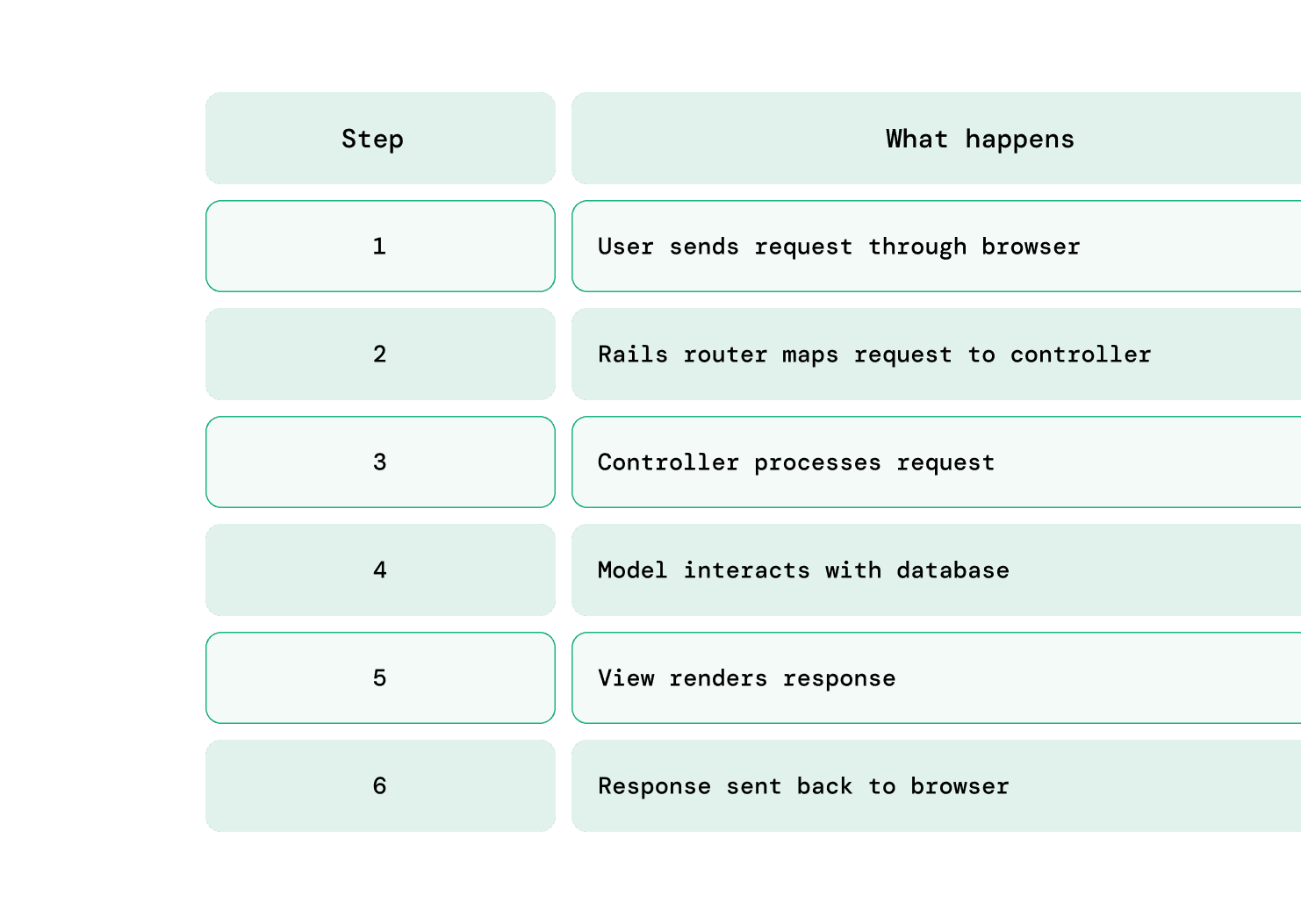
Let’s walk through a real example.
When a user visits:
/articles
Rails checks its routes file and sends the request to the ArticlesController. The controller runs the index action and fetches articles from the model. Rails then renders the corresponding view.
Finally, the browser displays the result. This entire process happens in milliseconds.This structured flow makes Rails applications predictable and easy to debug.
DO YOU KNOW? According to JetBrains’ State of Developer Ecosystem report 2025, 30% of developers identified debugging as one of their most time-consuming activities, and 27% find it to be one of the most difficult parts of their job.
Common mistakes and anti-patterns in Rails MVC
Even though Rails encourages clean separation, MVC architecture in Ruby on Rails can break down if responsibilities are mixed. These mistakes often make applications harder to scale, debug, and maintain.
Fat Controllers
Controllers should coordinate requests, not contain business logic. When controllers handle calculations or validations, they become difficult to test and reuse.
Fat Models
Moving all logic into models can make them overly complex and hard to maintain. This often happens when models take on responsibilities beyond core business rules.
Business Logic in Views
Views should only display data, not process it. Adding logic in views makes debugging difficult and breaks the separation between layers.
Skipping Rails Conventions
Ignoring Rails naming and structure conventions creates confusion. Rails works best when its standard patterns are followed consistently.
Tight Coupling Between Layers
Direct dependencies between views, controllers, and models reduce flexibility. This makes future changes and refactoring much harder.
Advanced MVC Techniques in Rails
As applications grow, Rails developers adopt additional architectural patterns to keep MVC clean and scalable. These techniques reinforce separation of concerns while preventing controllers and models from becoming overloaded.
Service Objects
Service objects encapsulate complex business workflows that don’t naturally belong in a single model. By moving multi-step operations, integrations, or transactional processes into dedicated classes, teams keep models lean and controllers focused on orchestration rather than implementation details.
Keeping Controllers Thin
Controllers should coordinate, not compute. Their primary responsibility is handling request flow, authentication, parameter filtering, and rendering responses. Moving business logic into models, services, or query objects improves readability, reduces duplication, and makes testing significantly easier.
Using Helpers for View Logic
Helpers extract reusable presentation logic from templates, such as formatting, conditional display rules, or UI-related transformations. This keeps views declarative and clean, while preventing HTML files from becoming cluttered with Ruby logic.
Using View Components or Presenters
In larger applications, View Components or Presenter patterns encapsulate UI behavior into structured, reusable units. This improves consistency across screens, simplifies testing of UI logic, and reduces duplication in complex front-end flows.
API-Focused MVC
In API-only Rails applications, the “View” layer shifts from HTML templates to structured JSON responses. While the presentation format changes, the MVC separation remains intact. Controllers handle requests, models manage data, and serializers or renderers shape the response payload.
Why MVC remains essential to Rails in 2026
MVC architecture in Ruby on Rails remains essential as it provides a clear structure that keeps applications organized as they grow in size and complexity.
One major advantage is parallel development. Frontend developers can work on views, backend developers can refine models, and others can improve controllers without stepping on each other’s work. This separation reduces conflicts and speeds up feature delivery, especially in larger teams.
MVC also improves maintainability over time. When business logic lives in models and presentation stays in views, debugging becomes more straightforward. Developers know exactly where to look when issues arise, which reduces troubleshooting time and improves long-term stability. This clarity becomes especially important during long-term software development initiatives or when planning a Rails upgrade, where clean MVC boundaries reduce risk and technical debt.
Another key strength is scalability without structural rewrites. Applications built with proper MVC separation can evolve from MVPs to enterprise platforms while keeping the same architectural foundation. This is one reason large-scale products like GitHub and Shopify have successfully scaled Ruby on Rails to support millions of users. For organizations looking to build or scale similar systems, partnering with experienced teams or choosing to hire dedicated Ruby on Rails developers can significantly accelerate delivery while maintaining architectural integrity.
Most importantly, MVC architecture in Ruby on Rails encourages good software design habits. By enforcing separation of concerns, it helps developers build applications that are easier to extend, test, and maintain, not just in Rails, but across any modern framework.
In 2026, MVC is not just a Rails feature. It remains one of the key reasons Rails continues to be a practical and reliable choice for building scalable and maintainable web applications at any stage of growth.