Human-in-the-Loop (HITL) Automation
Explore how HITL automation combines AI speed and scalability with human expertise, context, accountability, and decision-making.


Aravind S
Junior Software Developer


Introduction
"Artificial Intelligence can process millions of decisions every second, but knowing which decision should never be automated is still a uniquely human capability"
Enterprise automation has evolved rapidly, from rule-based Robotic Process Automation (RPA) to Intelligent Document Processing, Machine Learning, Large Language Models, and now autonomous AI agents capable of planning and executing complex workflows. The goal has always been the same: less manual effort, lower costs, and faster decisions.
But as AI grows more autonomous, one question keeps surfacing: should AI make every business decision on its own? For most enterprise processes, the answer is no. A wrong invoice payment, a fraudulent claim approved by mistake, or an unchecked medical recommendation can carry real financial, legal, and human costs.
AI excels at prediction, but accountability remains a human responsibility. That is why enterprises are shifting from fully autonomous AI toward Human-in-the-Loop (HITL) Automation - an approach where AI and human expertise work together, and people stay involved wherever judgment, ethics, or compliance is required. The result is automation that is faster, but also safer and more trustworthy.
Why Full AI Automation Isn't Enough
More automation doesn't automatically mean better outcomes. AI is excellent at recognizing patterns, but it lacks context: it can tell an invoice looks normal without knowing a supplier relationship just changed due to a merger; it can summarize a contract but miss the business implications an experienced lawyer would catch; it can recommend a loan approval from historical data while missing exceptional circumstances.
Enterprise decisions depend on more than data, they require context, experience, risk awareness, regulatory understanding, and ethical judgment. That gap between prediction and judgment is exactly where HITL automation becomes essential.
What Is Human-in-the-Loop (HITL) Automation?
HITL is an intelligent automation framework that deliberately brings human decision-makers into AI-driven workflows. Rather than letting AI act independently on everything, the system decides when human intervention is needed, based on predefined rules, confidence thresholds, or risk levels.
AI handles what it does best — processing information at speed and scale — while humans step in only when expertise, accountability, or nuanced judgment is required. Far from slowing things down, HITL keeps automation accurate, explainable, and aligned with business goals.
The Philosophy Behind HITL
The goal of HITL isn't to have AI and humans compete for the same work — it's to remove repetitive work while elevating human decision-making. Think of AI as an analyst preparing recommendations, and humans as the decision-makers validating critical outcomes. This is what researchers call Collaborative Intelligence: the strengths of each side compensate for the other's weaknesses.
| AI Strengths | Human Strengths |
|---|---|
| Speed | Judgment |
| Scalability | Experience |
| Pattern Recognition | Context |
| Data Processing | Ethics |
| Consistency | Creativity |
| 24×7 Operation | Accountability |
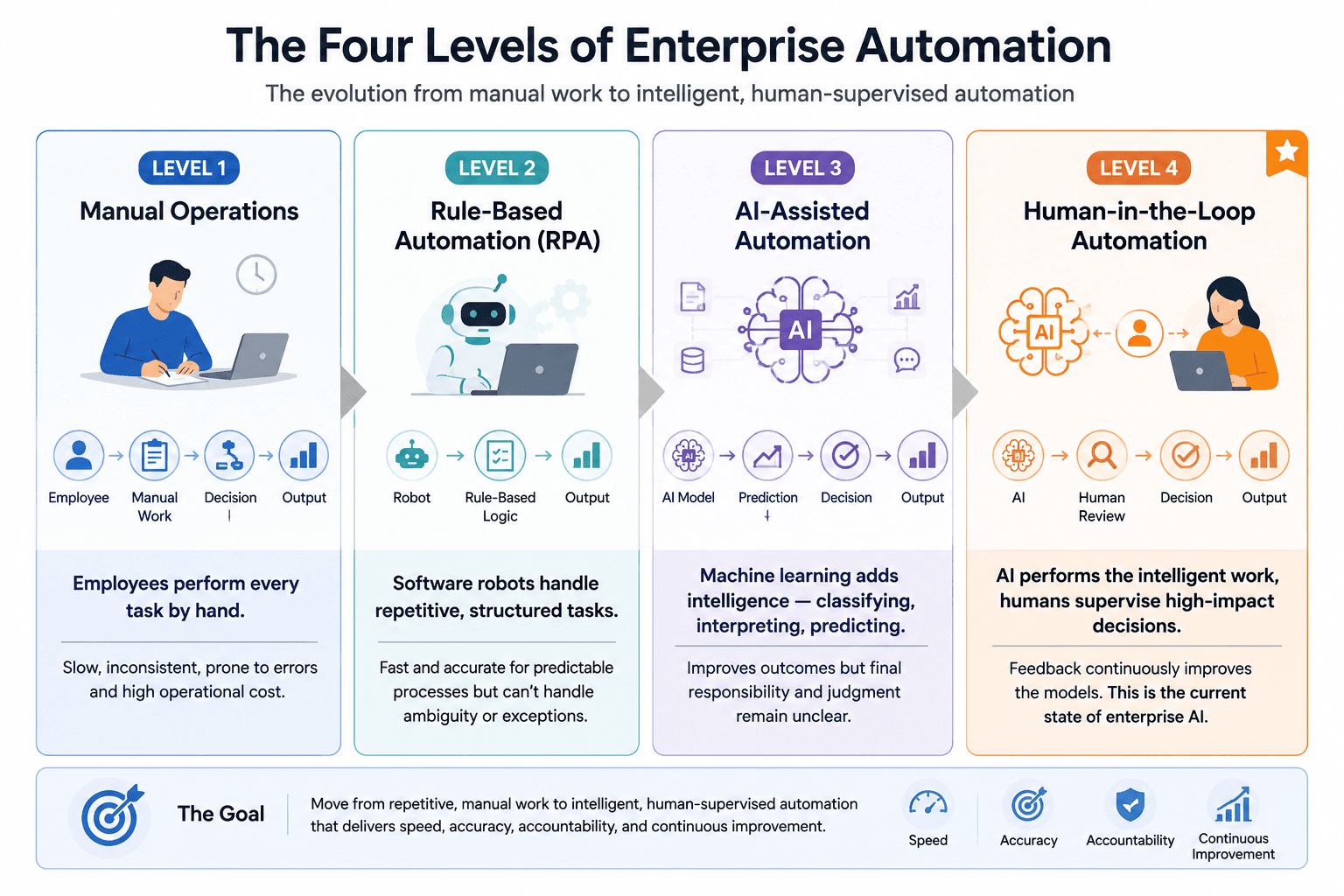
The Four Levels of Enterprise Automation
The HITL Decision Architecture
A common misconception is that humans review everything in a HITL system — that would defeat the purpose of automation. Instead, AI determines when it is confident enough to proceed on its own, guided by confidence, risk, and business policy rather than arbitrary intervention.
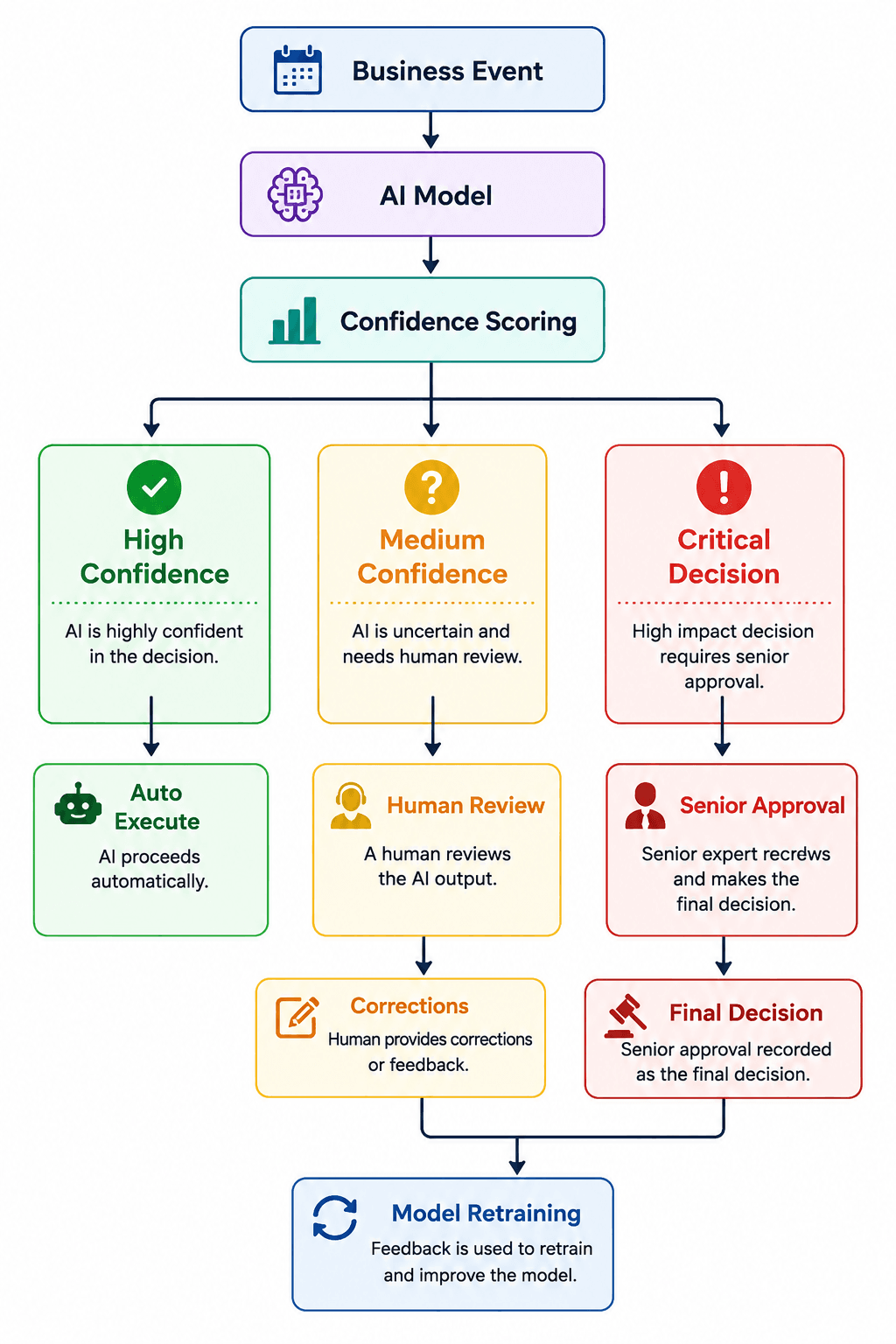
Confidence Scores: The Heart of HITL
Confidence scoring determines whether AI should act independently. For example, an invoice extraction model might produce the following field-level confidence:
| Field | Confidence |
|---|---|
| Invoice Number | 99.8% |
| Vendor Name | 99.1% |
| Tax Amount | 95% |
| Bank Account | 61% |
Instead of forcing employees to check every field, only the low-confidence bank account needs review — cutting manual effort while keeping accuracy high. Many organizations automate over 90% of cases and review only a small slice of exceptions.
Human Feedback Creates Better AI
Every human correction in a HITL system becomes new training data, driving a continuous improvement cycle: AI predicts, a human validates or corrects it, the correction is stored, models are retrained, accuracy improves, and human intervention decreases over time. This process — Active Learning — is why mature AI systems get more reliable the more real-world data they process.
HITL in Large Language Models
-
Generates content, summaries, translations, code, and answers questions quickly.
-
Can produce hallucinations, outdated information, and inconsistent reasoning.
-
Human review is required before critical outputs are used.
-
Common enterprise use cases include:
-
Legal contract drafting
-
Financial report generation
-
Medical documentation
-
Compliance reporting
-
Procurement decisions
-
AI accelerates content creation and analysis.
-
Humans validate, approve, and remain accountable for the final output.
HITL in Agentic AI
- Agentic AI systems can reason, plan, use tools, and execute multi-step workflows autonomously.
- AI agents can retrieve customer data, prepare recommendations, draft approvals, and initiate actions.
- Human authorization is required before irreversible or high-impact actions are executed.
- Human-on-the-Loop (HOTL) enables humans to supervise autonomous systems and intervene only when necessary.
- HITL provides the governance layer that balances AI autonomy with human accountability in multi-agent systems.
Enterprise Use Cases
Banking
AI assesses loan applications, detects fraud, and calculates credit risk; borderline cases are escalated to credit officers.
Healthcare
AI assists in diagnosis and image interpretation; physicians validate findings before treatment.
Insurance
High-confidence claims process automatically; suspicious or high-value claims go to adjusters.
Manufacturing
Computer vision flags defects; quality engineers inspect uncertain cases before products ship.
Customer Service
LLMs resolve routine queries; complex, emotional, or legally sensitive conversations go to human agents.
Legal
AI reviews contracts and flags clauses; lawyers validate recommendations before finalizing agreements.
Benefits of Human-in-the-Loop Automation
- Higher decision quality and reduced operational risk
- Improved regulatory compliance and transparency
- Greater customer trust and faster exception handling
- Continuous AI improvement and explainable decision-making
- Scalable automation without sacrificing governance
Best Practices
- Define risk-based confidence thresholds and automate routine decisions fully
- Route only ambiguous cases to human reviewers
- Maintain detailed audit trails and capture every correction as training data
- Continuously monitor and retrain models on validated enterprise data
- Measure both automation rate and review quality
The Future of HITL
HITL is evolving beyond simple approval workflows toward adaptive confidence thresholds, real-time human collaboration with AI agents, explainable AI built into every decision, risk-aware autonomous workflows, and multi-agent ecosystems supervised by human experts. Rather than replacing people, future AI systems will get better at knowing when they need human expertise.
Conclusion
Human-in-the-Loop Automation marks a real shift in how enterprises approach AI: the goal is no longer to automate everything, but to automate responsibly. By combining AI's speed and scale with human judgment, organizations build systems that are efficient, accurate, transparent, and trustworthy.
As enterprises adopt more LLMs, intelligent document processing, and autonomous agents, HITL's role as the governance layer — keeping critical decisions accountable while AI handles repetitive, data-intensive work — will only grow. The most successful organizations won't rely solely on humans or solely on AI; they'll design ecosystems where both complement each other to deliver better decisions and greater business value.