Hyperautomation: The Next Step in Digital Transformation
Learn what hyperautomation is, how it differs from traditional automation, and how AI, RPA, OCR, APIs, and orchestration work together.


Sandhya K
Junior Software Developer


Introduction
Businesses today are under constant pressure to deliver faster services, reduce operational costs, and improve customer experiences. While traditional automation has helped organizations eliminate repetitive tasks, it often automates only isolated activities rather than entire business processes.
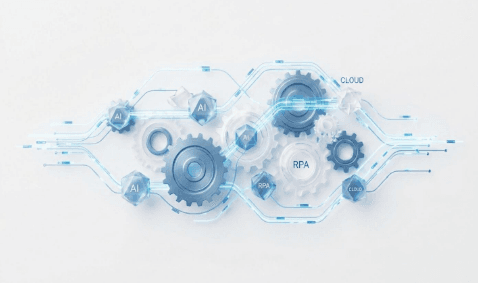
This is where hyperautomation comes in. By combining technologies such as Artificial Intelligence (AI), Robotic Process Automation (RPA), Optical Character Recognition (OCR), APIs, and workflow orchestration, hyperautomation enables organizations to automate complete end-to-end workflows. Instead of simply making individual tasks faster, it transforms how work flows across departments, systems, and people.
What is Hyperautomation?
Hyperautomation is an approach to business automation that integrates multiple technologies to automate complex processes from start to finish.
Unlike traditional automation, which focuses on repetitive rule-based tasks, hyperautomation creates intelligent workflows capable of understanding data, making decisions, communicating with multiple applications, and involving humans only when necessary.
Think of it as an orchestra. Each technology plays a different instrument, but together they create a seamless performance.
Traditional Automation vs. Hyperautomation
Imagine a company processing customer service requests.
With traditional automation:
- Emails are automatically sorted into folders.
- Attachments are saved.
- Notifications are sent.
Employees still review requests, enter data into systems, and update customers manually.
With hyperautomation:
- AI understands the customer's request.
- OCR extracts information from attached documents.
- APIs update CRM and ERP systems automatically.
- Workflow software routes requests to the appropriate team.
- Customers receive automatic status updates.
- Managers monitor the entire process through dashboards.
Instead of automating a single task, the entire customer journey becomes connected and intelligent.
The Technologies Behind Hyperautomation
Hyperautomation is not a single tool—it is the combination of several complementary technologies.
Artificial Intelligence (AI)
AI enables systems to understand language, recognize patterns, classify information, and make informed decisions. It allows automation to handle tasks that once required human judgment.

Robotic Process Automation (RPA)
RPA automates repetitive, rule-based actions such as copying data, filling forms, generating reports, and interacting with software applications.
Optical Character Recognition (OCR)
OCR converts printed or scanned documents into digital text, making invoices, receipts, contracts, and forms searchable and processable.
APIs
Application Programming Interfaces (APIs) connect different software applications, allowing data to flow automatically between systems without manual intervention.
Workflow Orchestration
Workflow orchestration coordinates every step of a business process, ensuring tasks happen in the correct sequence while managing approvals, notifications, and exceptions.
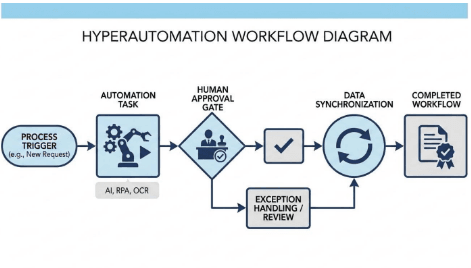
Analytics and Monitoring
Dashboards provide visibility into process performance, helping organizations identify bottlenecks, measure efficiency, and continuously improve operations.
A Real-World Example
Consider the employee onboarding process.
Without hyperautomation, HR personnel manually collect documents, create employee records, request laptops, configure email accounts, notify managers, and update payroll systems. These activities involve multiple departments and often take several days.
With hyperautomation, submitting a new employee's details triggers an automated workflow. Identity documents are verified, IT accounts are created, equipment requests are generated, payroll information is updated, welcome emails are sent, and managers receive onboarding schedules automatically. What previously required several manual steps across different teams becomes a single connected process.
Why Businesses Are Investing in Hyperautomation
Organizations adopting hyperautomation can expect several benefits:
- Faster process execution by eliminating manual handoffs.
- Reduced operational costs through efficient resource utilization.
- Improved accuracy by minimizing human errors.
- Enhanced customer experiences through quicker response times.
- Greater scalability as automation can handle increasing workloads.
- Better compliance with automated audit trails and standardized processes.
Rather than replacing employees, hyperautomation enables them to focus on strategic, creative, and customer-centric work.
Challenges to Consider
While the benefits are significant, successful hyperautomation requires careful planning.
Organizations should:
- Select the right processes for automation.
- Ensure data quality across systems.
- Integrate legacy applications effectively.
- Prepare employees for new ways of working.
- Continuously monitor and optimize automated workflows.
Technology alone does not guarantee success—well-designed processes and strong governance are equally important.
The Future of Hyperautomation
As AI continues to evolve, hyperautomation will become increasingly intelligent. Businesses are already exploring AI agents that can manage workflows, predict potential issues, and make recommendations before problems occur.
Future automation will not only execute tasks but also analyze situations, learn from outcomes, and continuously improve business processes.
Conclusion
Hyperautomation represents the next stage of digital transformation by connecting people, processes, and technologies into intelligent, end-to-end workflows. Instead of focusing on isolated automation projects, organizations can reimagine entire business operations to become faster, more efficient, and more resilient.
As industries continue their digital transformation journeys, hyperautomation is no longer just an emerging trend—it is becoming a strategic capability that enables businesses to innovate, scale, and stay competitive in an increasingly digital world.