Legacy Application Modernization: When to Modernize vs Rewrite
Learn when legacy application modernization makes sense and when a full software rewrite is the better option for scalability and long-term growth.


Pichandal
Technical Content Writer


Many businesses in 2026 still rely on legacy applications that power critical operations. The challenge is deciding whether to modernize the existing system or rewrite it completely. Application Modernization usually reduces risk and preserves business continuity, while rewrites offer architectural freedom but demand higher investment, longer timelines, and greater operational risk.
At RailsFactory, with nearly two decades of experience working on legacy systems, app modernization initiatives, and large-scale application rewrites, we’ve seen how difficult this decision can become for engineering and business teams alike.
This article breaks down when legacy application modernization makes practical sense, when a full rewrite may be justified, and how organizations can evaluate both approaches based on risk, scalability, technical debt, timelines, and business impact.
What Is Legacy Application Modernization?
Legacy application modernization is the process of improving older software systems to meet current business and technical requirements. Instead of replacing everything immediately, organizations update parts of the application gradually.
Modernization can involve:
-
Migrating applications to the cloud
-
Refactoring outdated code
-
Improving performance and security
-
Updating user interfaces
-
Breaking monoliths into microservices
-
Enabling API integrations
The goal is not simply to “refresh” technology. It is to make the application easier to maintain, scale, and adapt to future business needs.
A 2025 industry study found that enterprises lose an estimated $370 million annually due to legacy systems, technical debt, and failed modernization initiatives.
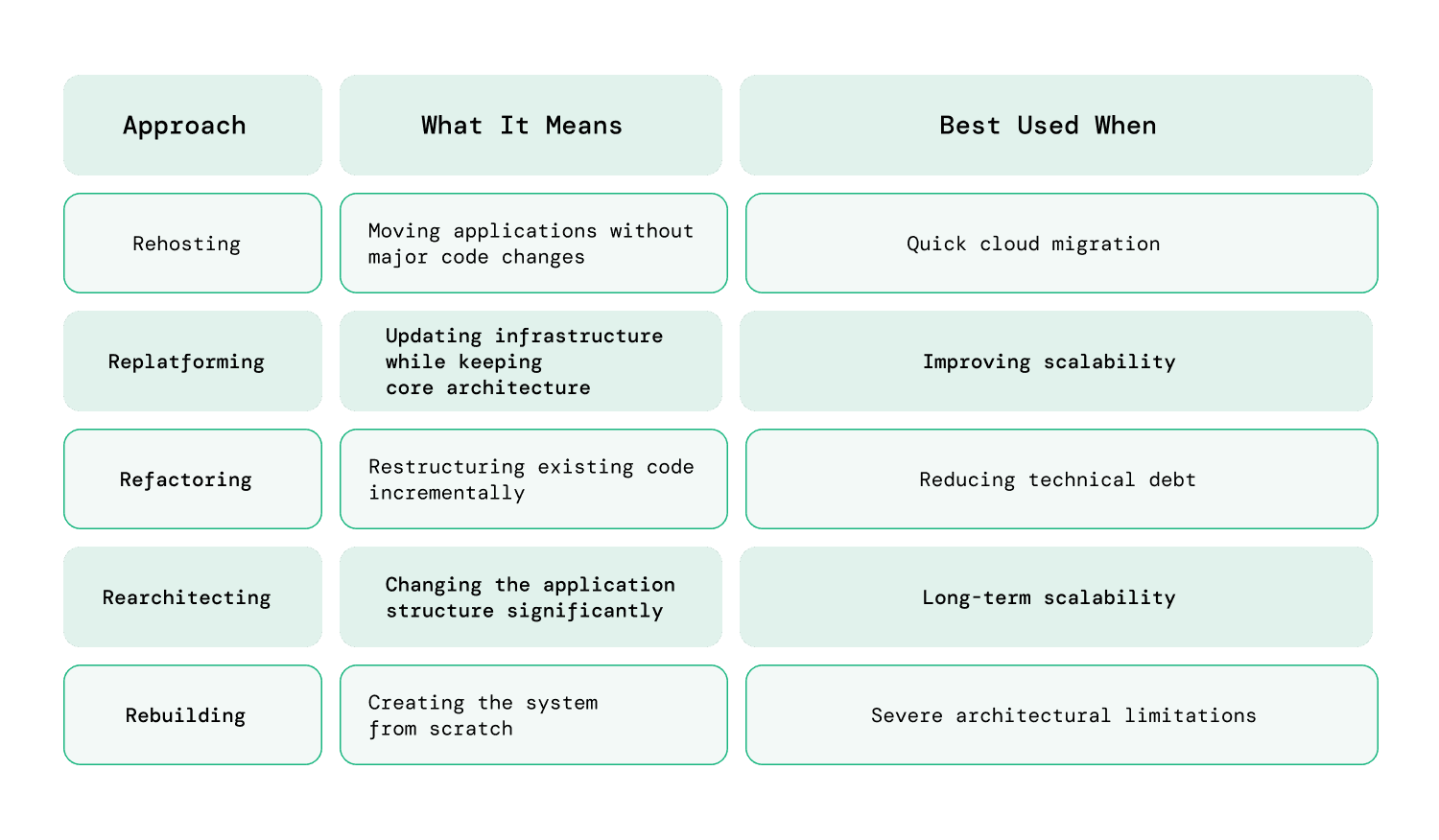
Common Legacy Modernization Approaches
Why Is the “Modernize vs Rewrite” Decision So Difficult?
Legacy systems often contain years of undocumented business logic. Rebuilding them is rarely as straightforward as replacing old code with newer frameworks.
Engineering teams may push for a rewrite because:
-
The tech stack feels outdated
-
Development velocity has slowed
-
Maintenance costs keep increasing
-
Modern integrations are difficult
Leadership teams, however, often prioritize:
-
Stability
-
Predictable budgets
-
Faster time-to-value
-
Reduced operational disruption
This creates tension between technical improvement and business continuity.
A complete rewrite promises a cleaner architecture. But many rewrites fail because organizations underestimate hidden workflows, integrations, and edge cases accumulated over years.
Statistics highlights that enterprises waste more than $370 million annually due to technical debt and inefficient modernization efforts.
When Should You Modernize a Legacy Application?
Modernization makes more sense when the application still delivers business value but struggles with maintainability, scalability, or performance.
Your Core Business Logic Still Works
If employees, customers, or internal teams still rely heavily on the system every day, that is a strong sign the application still delivers business value.
For example, an insurance platform built 12 years ago may still handle policy calculations accurately because the business rules have matured over time. Rebuilding those rules from scratch introduces risk, especially when documentation is incomplete.
In such cases, app modernization focuses on improving the surrounding ecosystem instead of replacing proven business logic.
This approach allows organizations to improve engineering efficiency without disrupting stable workflows.
Business Disruption Must Stay Minimal
Some enterprise systems cannot tolerate extended downtime.
Industries like:
-
Healthcare
-
Finance
-
Logistics
-
Manufacturing
often rely on systems that run continuously.
For them, a full rewrite may require parallel systems, extended testing cycles, or risky cutover periods. Modernization reduces this risk by allowing teams to upgrade the system incrementally while production operations continue normally.
For example: A retailer may modernize its inventory APIs first or a hospital may update patient portals separately from backend systems
These smaller modernization phases are easier to validate and roll back if issues appear.
You Need Faster Results and Lower Risk
Rewrites often require large investments before businesses see measurable improvements.
Modernization delivers value incrementally.
Instead of waiting 18–24 months for a completely new platform, organizations can improve:
-
Performance
-
Scalability
-
Security
-
User experience
-
Infrastructure efficiency
within shorter delivery cycles.
For example:
-
Moving workloads to cloud infrastructure may reduce infrastructure costs quickly
-
API enablement may accelerate partner integrations
-
UI modernization may improve customer adoption without backend replacement
These smaller wins help organizations reduce operational friction while continuing broader modernization efforts over time.
The Application Is Too Large to Rewrite Safely
Large enterprise systems rarely behave exactly as documentation suggests.
Over time, teams introduce:
-
Manual workarounds
-
Hidden integrations
-
Department-specific workflows
-
Unofficial reporting dependencies
These “invisible dependencies” are one of the biggest reasons software rewrites fail.
For example, a finance application may contain tax-processing logic added years ago for specific regions. That logic may never appear in formal documentation, but removing it accidentally can impact operations immediately.
Modernization reduces this risk because teams can:
-
Observe live behavior
-
Replace components gradually
-
Validate business processes incrementally
This is often far safer than attempting a full rebuild based on incomplete assumptions.
When Is a Full Rewrite the Better Option?
Some applications become so difficult to maintain that modernization no longer provides meaningful long-term value.
In these cases, rewriting the system may be justified.
The Technology Stack Is Obsolete
Certain legacy technologies become difficult to support because:
-
Vendors discontinue updates
-
Security patches stop arriving
-
Developer availability declines
If hiring experienced developers becomes increasingly difficult, maintaining the application may become unsustainable.
The Architecture Cannot Support Future Growth
Some applications were built for business environments that no longer exist.
Modern requirements may include:
-
Real-time processing
-
Global scalability
-
Mobile-first experiences
-
AI integration
-
Cloud-native deployment
If the architecture fundamentally blocks these capabilities, modernization may only delay larger problems.
Technical Debt Has Become Unmanageable
Technical debt becomes dangerous when:
-
Small changes trigger system-wide failures
-
Release cycles slow dramatically
-
Bug resolution consumes most engineering time
At this stage, modernization efforts may cost nearly as much as rebuilding.
Business Requirements Have Changed Completely
Sometimes the application no longer reflects how the business operates.
For example:
-
A desktop-first platform may need mobile-first workflows
-
Manual operations may require automation
-
Legacy reporting systems may need real-time analytics
If the product itself must evolve substantially, rewriting may provide more flexibility.
Security and Compliance Risks Are Severe
Older applications often struggle with:
-
Modern authentication standards
-
Data privacy regulations
-
Encryption requirements
-
Auditability
In highly regulated industries, security limitations alone may justify rebuilding.
Put simply, Rewrites become viable when architectural limitations prevent future business growth and modernization no longer delivers meaningful returns.
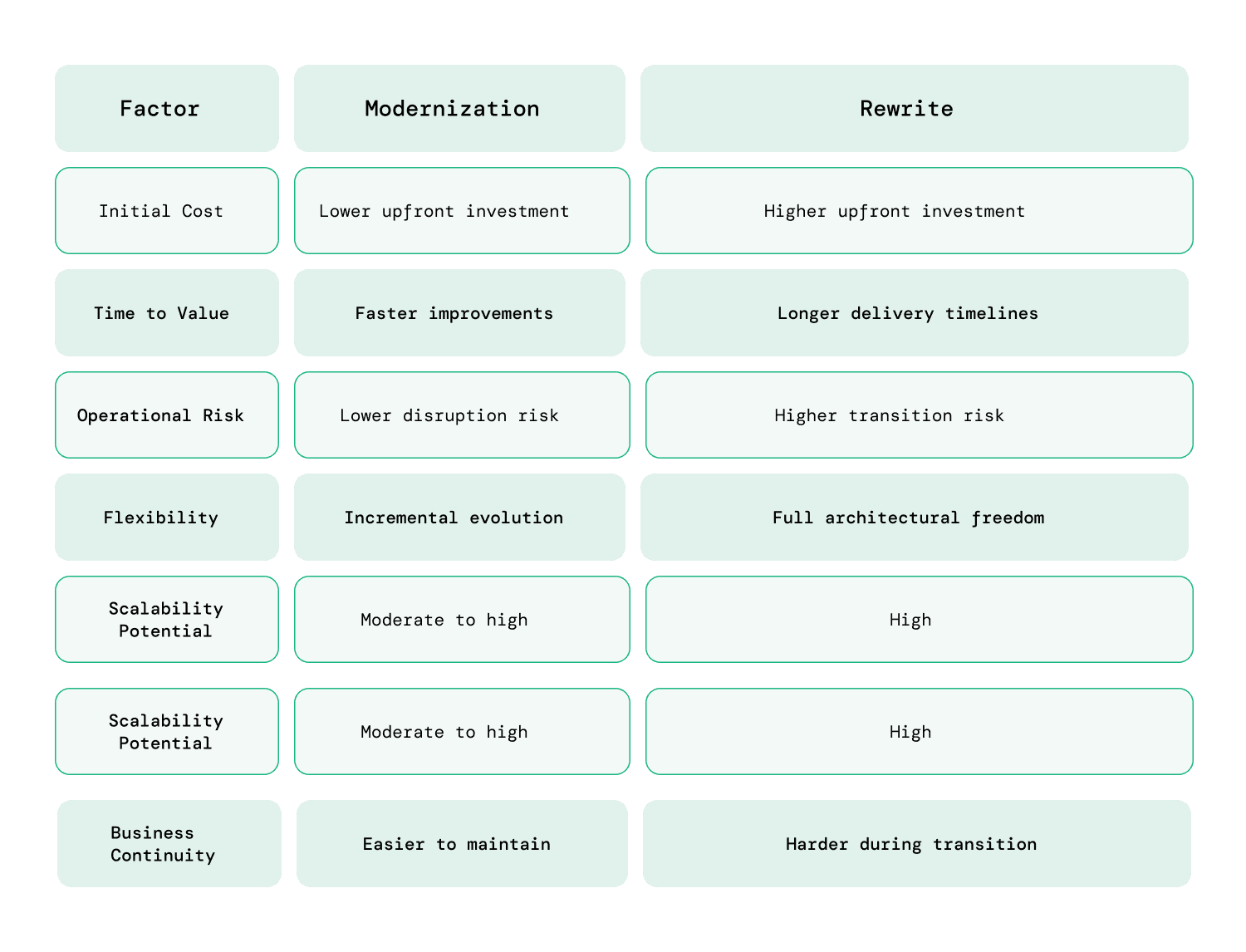
Modernization vs Rewrite: What’s the Difference?
The right choice depends on balancing risk, cost, scalability, and business continuity.
Can You Combine Modernization and Rewriting?
Yes, and many organizations now follow this hybrid strategy.
Instead of rebuilding everything, teams:
-
Modernize stable components
-
Rewrite high-risk modules selectively
-
Introduce APIs around legacy systems
-
Replace services gradually
One common modernization pattern is the Strangler Fig approach. New functionality is built separately while older modules are replaced incrementally over time.
This approach helps organizations:
-
Reduce risk
-
Preserve business continuity
-
Deliver improvements faster
-
Spread investment over multiple phases
A phased roadmap is often easier to manage than a large, multi-year rewrite initiative.
What Questions Should You Ask Before Choosing?
Before deciding whether to modernize or rewrite, organizations should evaluate both technical and business factors carefully.
Key questions include:
-
Is the current system still delivering business value?
-
Can the architecture support future growth?
-
How much undocumented logic exists?
-
What level of downtime is acceptable?
-
Are maintenance costs becoming excessive?
-
Does the business need rapid innovation?
-
How critical is time-to-market?
-
What is the team's capacity and skill set?
-
How stable are the business requirements?
-
What does failure look like, and how recoverable is it?
These questions help teams avoid emotional or trend-driven decisions.
The best modernization decisions balance technical feasibility, operational stability, and long-term business goals.
Modernize Smartly, Rewrite Selectively
There is no universal answer to modernization versus rewrite debate. The right path depends on business priorities, technical limitations, operational risk, and long-term scalability needs.
Modernization is often the safer option when the application still delivers business value and gradual improvement is possible. Rewrites become practical when the architecture fundamentally limits growth or maintenance costs become unsustainable.
Today, many organizations are moving toward hybrid modernization strategies instead of all-or-nothing approaches. By modernizing selectively and rewriting only where necessary, businesses can reduce risk while still preparing their systems for future growth.
If you’re looking for the right guidance partner, RailsFactory helps businesses with custom app development and application modernization strategies built for long-term scalability and maintainability.
From legacy application modernization to full platform rewrites, the RailsFactory team is here to help you evaluate the right approach and move forward with confidence.