What Does Ruby on Rails Application Support & Maintenance Actually Cost? (2026)
A practical look at Ruby on Rails maintenance costs, common cost drivers, and why proactive maintenance is often cheaper than modernization efforts.


Pichandal
Technical Content Writer


Ruby on Rails has always been known for speed.
Teams use it to launch products quickly, iterate faster, and ship with smaller engineering teams. But the economics of Rails are often misunderstood after the product goes live.
Because the real cost of a Rails application is not determined during development.
It is determined by how maintainable the application remains three, five, or even ten years later.
This is where many businesses get caught off guard.
Rails applications rarely become expensive overnight. The decline is usually gradual and operational.
-
A Rails upgrade gets postponed because roadmap priorities feel more urgent
-
A few gems stop receiving updates
-
Test reliability drops slightly, but not enough for anyone to stop releases
-
Deployment workflows become fragile
-
Developers begin avoiding certain parts of the application because changing them feels risky
None of these problems seem catastrophic individually.
But together, they slowly change how engineering teams behave.
This is where Ruby on Rails maintenance costs begin rising.
Not because Rails becomes inefficient. But because the organization gradually loses confidence in evolving the application safely.
That distinction matters.
In 2026, the most expensive Rails applications are usually not the ones with the largest cloud bills.
They are the ones where operational friction quietly became part of everyday development.
What Ruby on Rails Application Support & Maintenance Actually Includes
Legacy Rails application maintenance is often reduced to bug fixes and support tickets.
In reality, modern Rails maintenance is about preserving engineering velocity.
A healthy Rails application is not simply one that stays online. It is one that teams can continue evolving confidently without every release feeling risky.
That requires ongoing operational work.
Ruby and Rails upgrades are only one part of the equation. Modern Ruby on Rails maintenance typically includes a range of application maintenance services such as:
-
Dependency management and gem compatibility updates
-
Security patching and vulnerability remediation
-
CI/CD workflow maintenance
-
Observability and monitoring improvements
-
Infrastructure refinement and deployment optimization
-
Keeping the test suite reliable enough that developers trust it
The important point is that most maintenance work exists to prevent future slowdowns.
For example, weak test coverage rarely becomes a visible problem immediately. The impact appears gradually in delivery behavior. Teams start manually verifying changes that should have been automated. Developers become hesitant to refactor older workflows because rollback confidence is weak. Releases require more coordination because regressions feel harder to predict.
Eventually, engineering teams stop optimizing for speed and start optimizing for caution.
That shift becomes expensive very quickly.
This is why many mature organizations increasingly treat maintenance as operational investment rather than technical cleanup.
The goal is not simply to keep the application running but to keep it easy to evolve.
Why Businesses Invest in Continuous Ruby on Rails Maintenance
Maintenance Is Cheap Until It Turns Into Recovery
Ruby on Rails maintenance stays relatively affordable when it remains continuous operational work and becomes expensive when it turns into recovery work.
That is the pattern most engineering organizations eventually live through, not once, but repeatedly.
Applications evolve alongside their ecosystems whether teams actively maintain them or not. Ruby versions change. Gems get deprecated. Security expectations tighten. Deployment standards mature. Infrastructure assumptions shift underneath the surface.
Applications that evolve gradually alongside those changes stay manageable. This is why many organizations invest in legacy Rails application maintenance programs before operational risks become expensive modernization projects.
Small Delays Quietly Compound Operational Risk
At first, the consequences seem minor:
-
A skipped upgrade here
-
A deprecated gem warning there
-
Slightly slower deployments
-
More manual steps creeping into release verification
But the operational cost compounds faster than most teams notice, because each deferred decision slightly increases the risk of the next one.
Teams begin postponing upgrades because they feel risky. Refactoring slows because the codebase becomes harder to reason about. New developers take longer to ramp up because too much operational knowledge lives inside two or three engineers' heads rather than in documentation, tooling, or repeatable processes.
Eventually, the organization is no longer paying for maintenance alone. It is paying to recover maintainability and that is a fundamentally different kind of work.
Technical Debt Reduces Engineering Throughput
A company investing a few thousand dollars monthly in consistent application maintenance services may avoid a six-figure modernization project later.
Because the technical debt does not just sit quietly in a backlog, it actively slows every piece of work being done around it.
A feature that should take three days starts taking seven. Developers spend additional time understanding fragile workflows, validating side effects, and compensating for systems they cannot fully trust. That compounding friction slowly turns into a much bigger headache later.
Meanwhile, organizations that postpone maintenance often discover that large upgrades become cross-functional initiatives affecting infrastructure, deployment pipelines, gem dependencies, frontend architecture, and test reliability all at once. What should have been a phased upgrade becomes a coordinated migration with organizational risk attached to it.
This is what makes technical debt behave differently from most operational costs.
Infrastructure costs increase as traffic grows. But technical debt increases every time developers hesitate to make changes because the system feels fragile or difficult to work with. Over time, even small updates start taking significantly more effort than they should.
What Actually Drives Ruby on Rails Maintenance Costs in 2026
Delayed Rails and Ruby Upgrades
No single factor generates more concentrated maintenance cost than falling behind on Rails and Ruby versions.
When teams stay current, each upgrade is a contained, manageable effort. When multiple versions accumulate, the upgrade becomes an initiative, the one that touches controllers, models, configuration, middleware, and often the test suite simultaneously.
The cost difference is not linear. Upgrading from Rails 6.1 to 7.0 might take a senior engineer a few focused days. On the other hand, upgrading from Rails 5 to Rails 7 is a multi-week project with real regression risk, often requiring intermediate upgrades through each major version instead of a single jump.
Ruby version delays create a similar problem. Older Ruby versions eventually lose security support, especially for applications handling sensitive user data. Running on an end-of-life Ruby version becomes an active liability that security audits increasingly flag.
The cost of staying current is low. The cost of catching up is not.
Weak Test Coverage and Reliability
Test reliability determines how expensive every other maintenance activity becomes.
This is the factor most maintenance cost discussions underweight. Teams focus on upgrade timelines, dependency audits, and infrastructure overhead, but the condition of the test suite sits underneath all of them.
The problem rarely announces itself. It accumulates.
When tests fail inconsistently, developers stop trusting the suite. They rerun tests multiple times, rely on manual verification, and avoid refactoring because they cannot trust the feedback. Over time, hesitation slows delivery and increases release anxiety.
Low test coverage makes the situation worse. Applications with untested business logic are harder to upgrade, extend, and hand off without introducing regressions that surface later in production.
Teams providing legacy Rails application maintenance often prioritize test reliability because it directly impacts upgrade safety and development velocity.
In Rails applications especially, the difference between a well-tested codebase and a poorly-tested one becomes obvious during maintenance work.
Dependency Management and Ecosystem Drift
Every Rails application sits on top of an ecosystem that never stays still.
Dependency drift happens when a Gemfile, infrastructure assumptions, and third-party integrations gradually fall out of sync with where the ecosystem has moved. It builds quietly and usually surfaces only when something breaks during an upgrade or change.
A gem that was actively maintained a few years ago may now be deprecated. A third-party API may have introduced version changes. Individually, these are manageable. Together, they create a widening gap between the application and its surrounding ecosystem.
The real cost comes from compounding.
Once dependencies start drifting, updates stop being independent. One gem update depends on another. That update may require a newer Ruby version. That Ruby upgrade may conflict with existing infrastructure constraints.
What should have been routine maintenance turns into a sequencing problem, where engineering time is spent just figuring out the correct order of changes.
Typical Ruby on Rails Maintenance Cost Ranges in 2026
The commonly accepted benchmark still applies: annual application maintenance generally costs around 15–25% of the original development cost.
But for Rails applications, that benchmark becomes misleading without operational context.
Two applications built for similar budgets can have completely different long-term support and maintenance economics.
A well-maintained Rails application with disciplined upgrades, stable deployment workflows, reliable tests, and healthy dependency management can remain surprisingly cost-efficient for years.
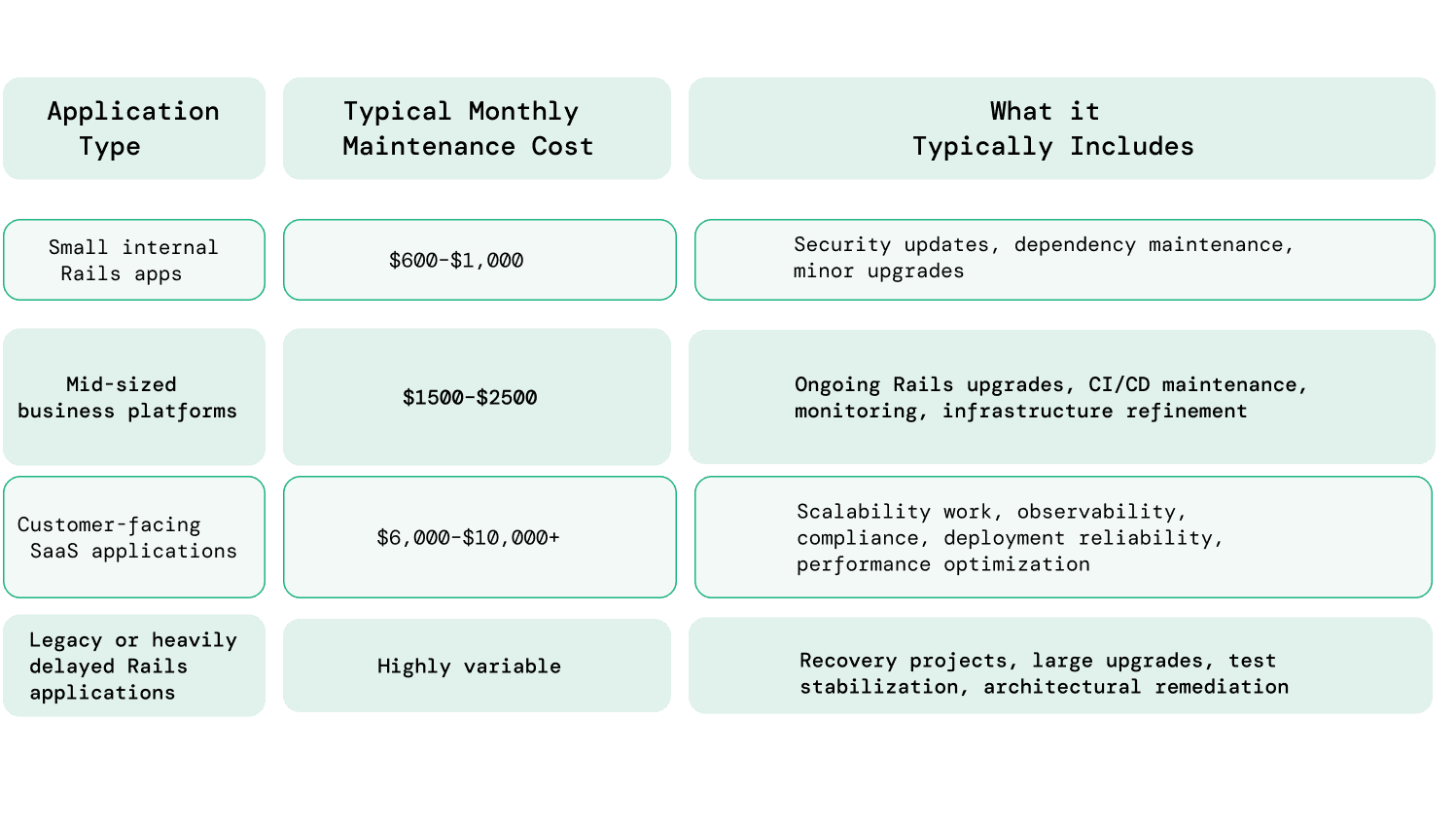
Organizations that invest in legacy Rails application maintenance typically experience fewer large-scale modernization projects and more predictable support costs.
Where AI Is Changing Rails Maintenance in 2026
AI-assisted tooling is already changing how Rails teams approach maintenance work.
Developers increasingly use AI for dependency analysis, debugging assistance, upgrade remediation, test generation, log interpretation, and operational diagnostics.
That reduces the time spent on repetitive maintenance tasks and accelerates issue resolution.
But AI does not eliminate technical debt.
It cannot compensate for years of deferred upgrades, tightly coupled architecture, weak observability, unreliable deployment workflows, or unstable test suites.
The organizations benefiting most from AI-assisted maintenance are usually the ones that already maintain operational discipline.
AI accelerates healthy systems more effectively than unstable ones.
The next wave of innovation is likely to go beyond AI-assisted development and into AI-driven maintenance operations, where monitoring, dependency management, upgrade planning, security remediation, and operational insights become increasingly automated.
At RailsFactory, we're actively exploring this space and building toward a more intelligent, AI-powered approach to application maintenance for Rails and other modern applications. More on that soon.
Conclusion
Rails maintenance costs are rarely determined by the framework itself. They are shaped by how consistently an application is upgraded, monitored, and maintained over time.
Organizations that invest in continuous maintenance typically avoid the larger costs associated with technical debt, delayed upgrades, and recovery projects.
With nearly two decades of experience in the Rails ecosystem, we've helped businesses maintain, modernize, and scale their applications through proactive support, Rails upgrades, and custom application development. Our approach is centered on helping organizations keep costs predictable while ensuring their applications remain secure and ready for future growth.
Whether you need ongoing Ruby on Rails maintenance services, support for a legacy application, or want to hire Rails experts to strengthen your team, contact the team at RailsFactory. We’re here to help!