Why Enterprise Automation Isn't Low-Code vs. Pro-Code: It's Low-Code + Pro-Code
Explore why modern enterprise automation relies on hybrid architecture, combining rapid low-code delivery with robust pro-code scalability and integration.


Siva Sakthii U S
Junior Software Developer


The rise of low-code platforms has sparked an ongoing debate within the software industry: Will low-code replace traditional software development? While some see visual development as the future of application delivery, others argue that enterprise systems will always depend on professional software engineering.
In reality, successful organizations have already moved beyond this debate.
Enterprise automation today isn't about choosing between low-code and pro-code. Instead, it's about combining both to build solutions that balance rapid delivery with scalability, security, and maintainability. As organizations accelerate digital transformation while managing increasingly complex technology ecosystems, the question is no longer "Which approach is better?" but rather "Which approach is best suited for each part of the solution?"
The Evolution of Enterprise Automation
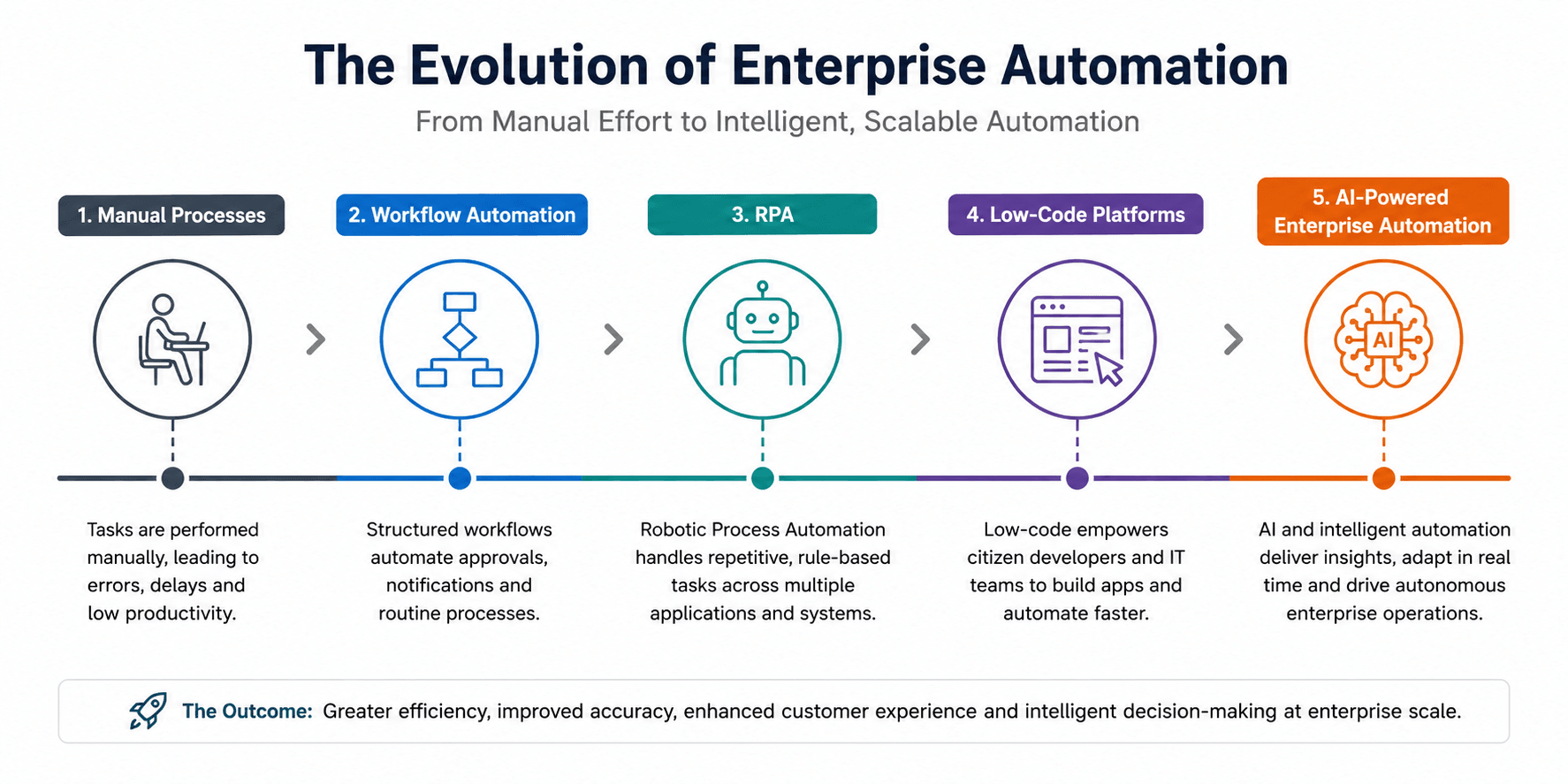
Enterprise automation has evolved significantly over the last decade. Initially, automation focused on eliminating repetitive manual tasks through workflow engines and robotic process automation. Today, business processes span multiple cloud platforms, enterprise applications, AI services, and external systems.
At the same time, businesses expect new solutions to be delivered in weeks instead of months. Low-code platforms emerged to address this demand by enabling rapid development of forms, workflows, dashboards, and integrations using visual tools.
However, increasing delivery speed doesn't reduce application complexity. Modern enterprise systems still require custom APIs, advanced security, AI capabilities, large-scale integrations, and governance. Rather than replacing software development, low-code has become another layer within enterprise architecture, working alongside professionally developed services.
Where Low-Code Creates Value
Low-code platforms excel at solving standardized business problems.
Applications such as employee onboarding, leave management, purchase approvals, service requests, and internal business portals often share common patterns. They require forms, approval workflows, notifications, authentication, reporting, and integrations with enterprise systems.
Instead of building these capabilities repeatedly through traditional programming, low-code platforms provide reusable components and pre-built connectors. This allows organizations to deliver business applications much faster while reducing repetitive development effort.
Low-code also encourages greater collaboration between business users and IT teams. Automation engineers and business analysts can rapidly prototype and improve processes, allowing development teams to focus on solving more complex engineering challenges.
The value of low-code lies not in eliminating software development but in accelerating the implementation of common business capabilities.
Where Pro-Code Remains Essential
While low-code accelerates application delivery, it is not designed to solve every engineering challenge.
Enterprise systems frequently require capabilities such as:
- High-performance APIs
- Complex business rules
- AI and machine learning services
- Event-driven architectures
- Legacy system integration
- Custom authentication and authorization
- Large-scale data processing
- Performance optimization
These scenarios require the flexibility and control provided by professional software development.
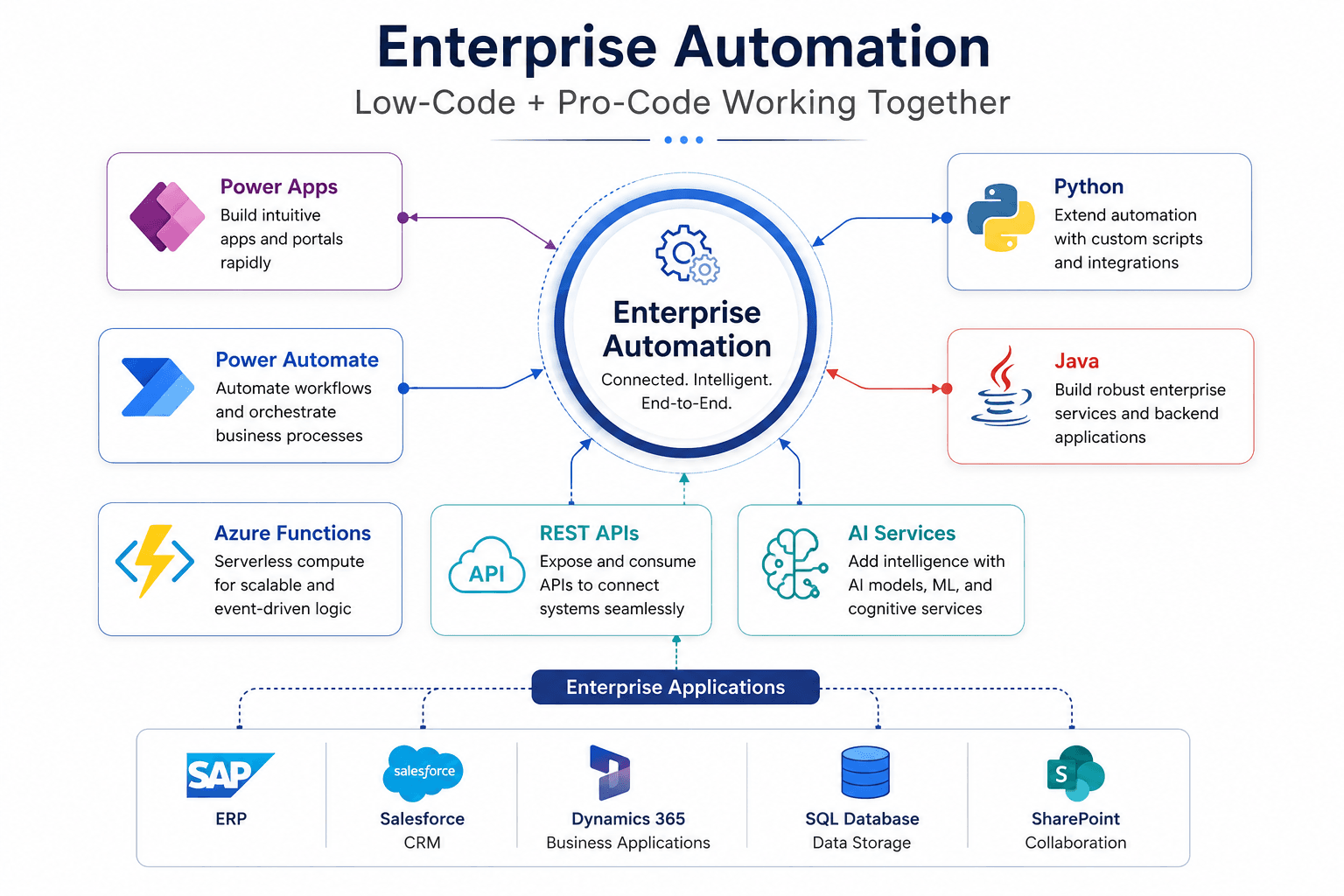
Technologies such as .NET, Java, Python, Azure Functions, AWS Lambda, and microservices enable developers to build scalable, reusable services that support enterprise-wide applications.
Rather than viewing this as a limitation of low-code, it should be seen as a natural architectural boundary. Visual platforms simplify standardized business processes, while professional development handles the complex logic that powers modern enterprise systems.
Hybrid Architecture: The Best of Both Worlds
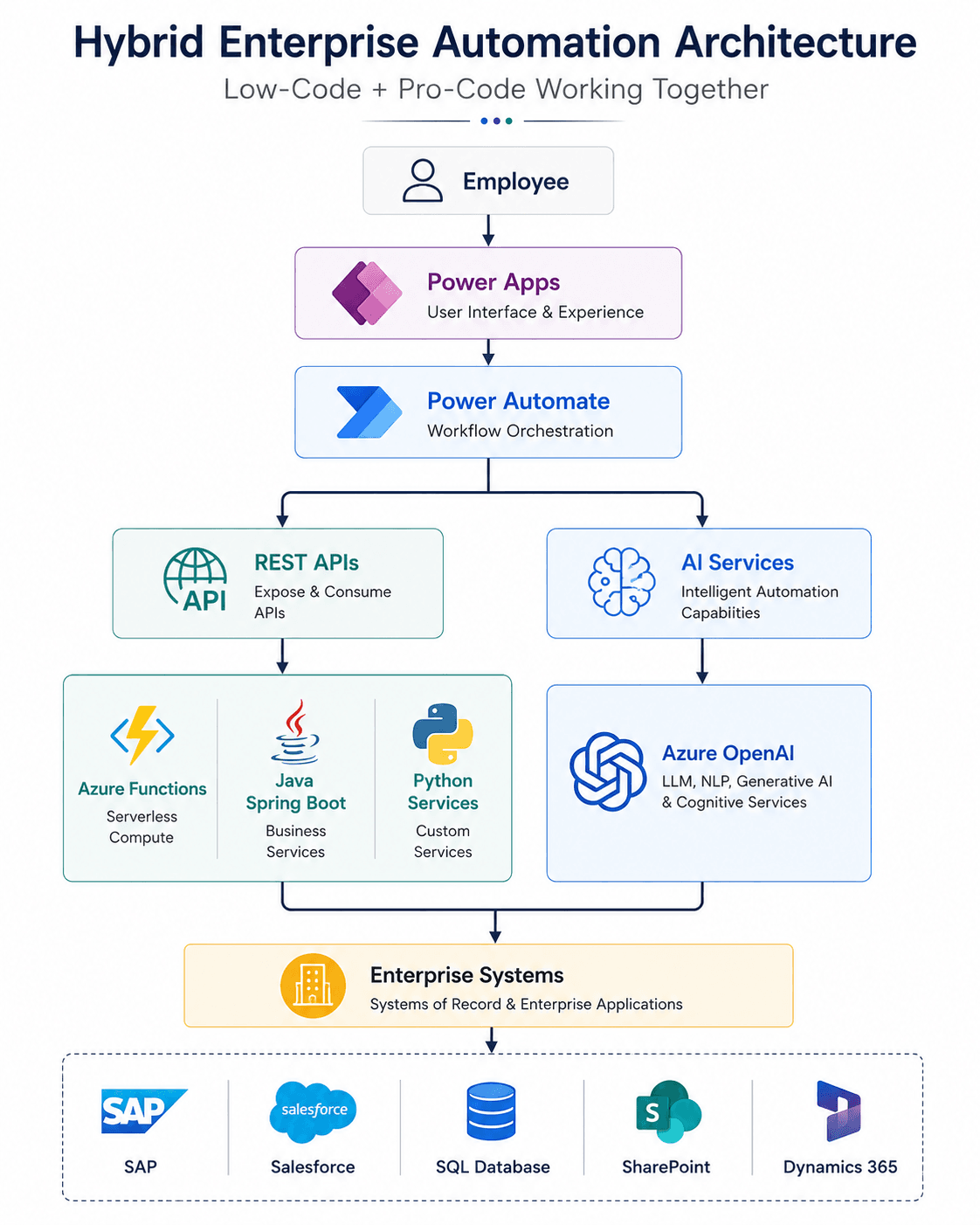
The most successful enterprise automation solutions combine low-code and pro-code within a single architecture.
Consider an employee onboarding process. A Power Apps application captures employee information through a user-friendly interface. Power Automate orchestrates approvals and workflow execution. When complex business validations or integrations are required, the workflow invokes custom APIs developed using Java, Python, or .NET. These services interact with identity providers, HR platforms, or ERP systems before returning the results to the workflow.
To the end user, the solution appears as a single application. Behind the scenes, multiple technologies collaborate, each handling the responsibilities it performs best.
This layered architecture improves scalability, simplifies maintenance, enables independent deployments, and allows engineering teams to evolve backend services without affecting business-facing applications. Hybrid development is therefore not a compromise, it is an architectural strategy that combines development speed with engineering flexibility.
Fusion Development: Building Together
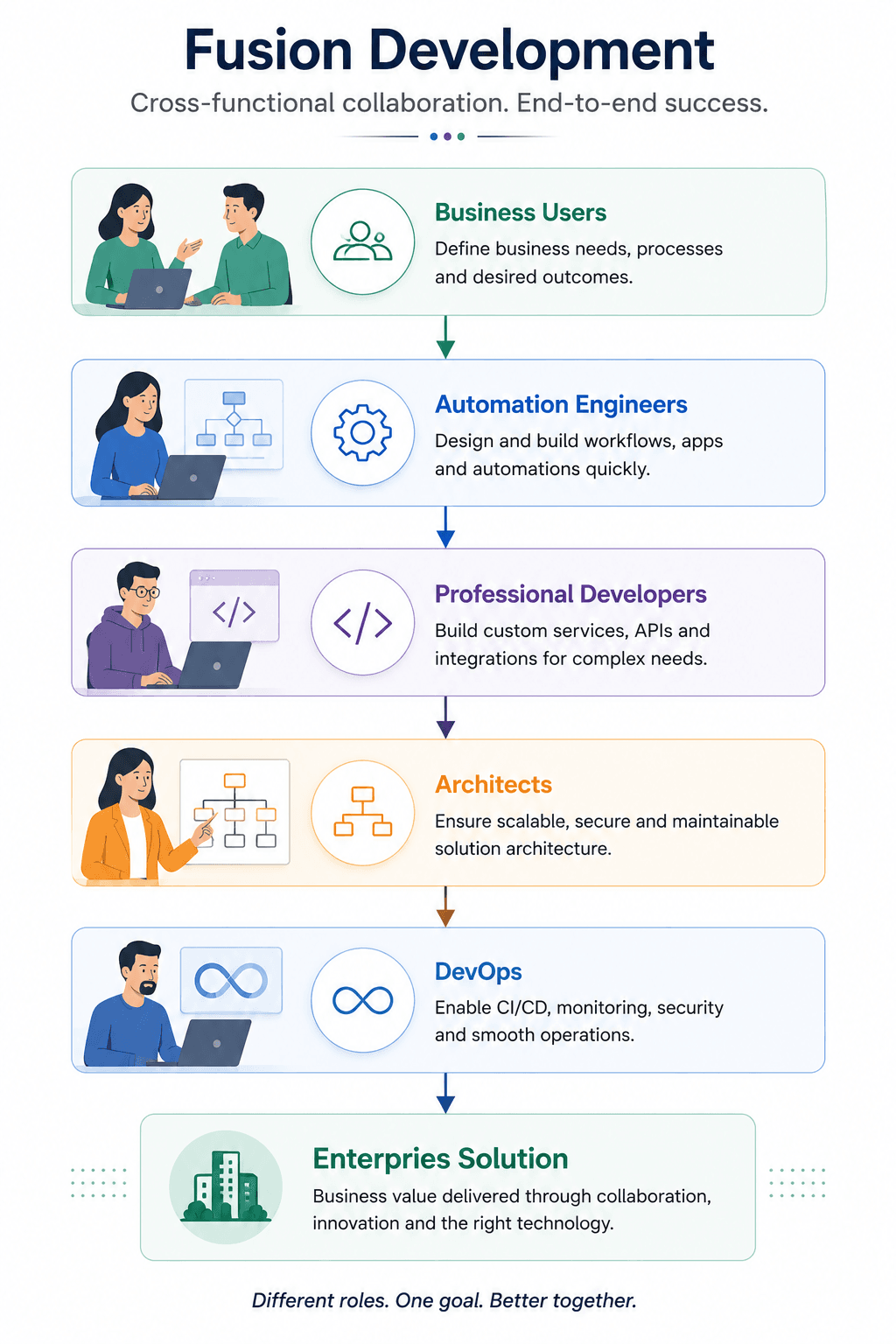
As enterprise automation matured, organizations also changed how teams collaborate.
Microsoft introduced the concept of Fusion Development, where business users, citizen developers, automation engineers, professional developers, architects, and IT teams contribute to a shared solution instead of working in isolated silos.
Business teams contribute process expertise, automation engineers rapidly build workflows and user interfaces, while professional developers create reusable APIs, integrations, and backend services. Architects establish design standards, and DevOps teams manage deployment pipelines and operational governance.
This collaborative model allows organizations to deliver solutions faster while maintaining enterprise engineering standards.
AI Is Enhancing Enterprise Automation
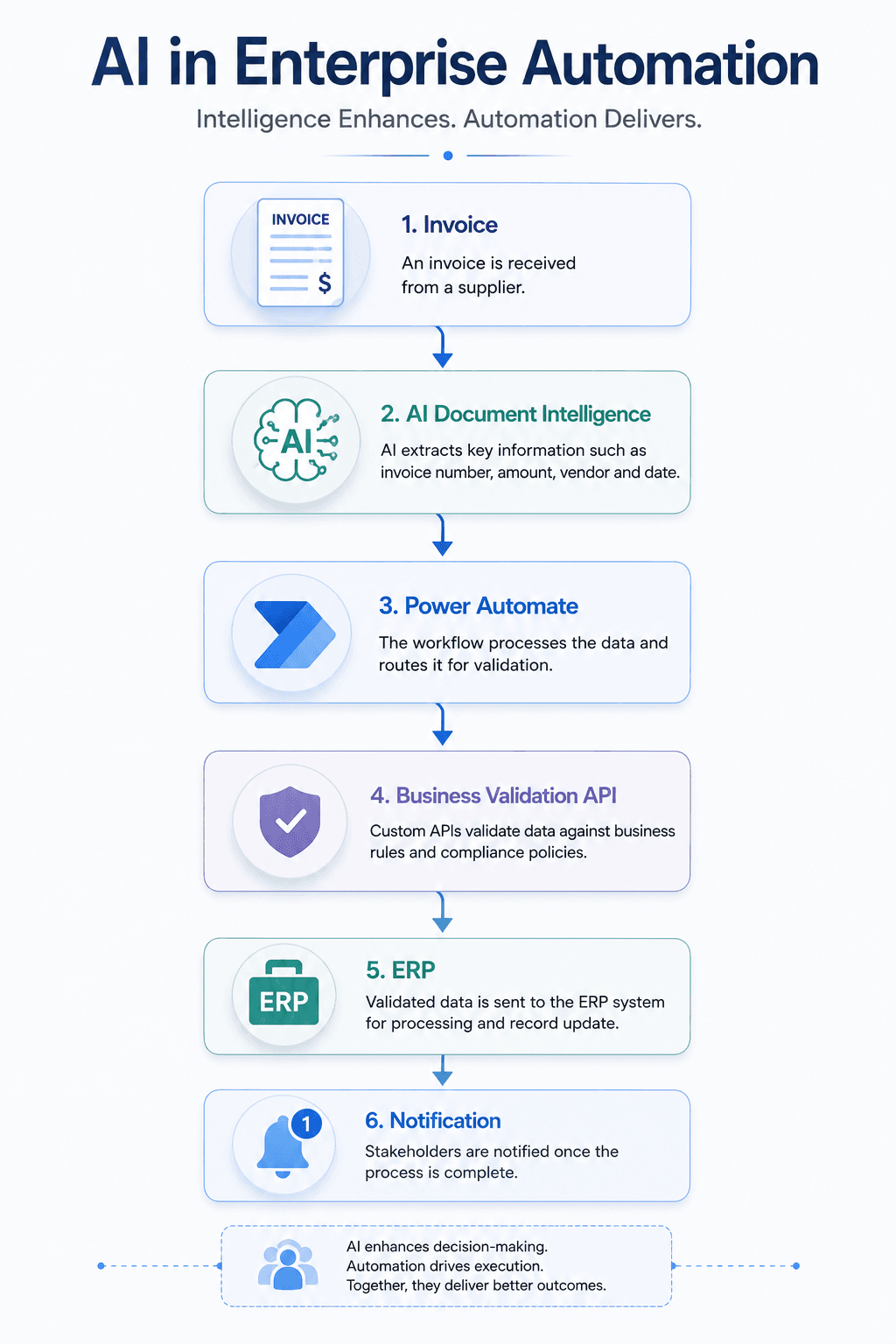
Artificial Intelligence is becoming a core capability within enterprise automation rather than a replacement for it. AI services can extract information from documents, summarize content, classify requests, or generate responses using large language models. However, AI alone cannot execute end-to-end business processes.
Once AI generates a result, workflows still need to validate business rules, update enterprise applications, notify stakeholders, and maintain audit trails.
This is where automation platforms and professional software development continue to play a critical role.
Modern enterprise solutions increasingly integrate AI services into automation workflows, allowing each technology to focus on its strengths while maintaining a modular, maintainable architecture.
Governance Enables Scalable Automation
Rapid development without governance often leads to duplicated applications, inconsistent standards, unmanaged connectors, and growing technical debt.
Successful organizations therefore apply the same engineering discipline to low-code platforms as they do to traditional software development.
This includes:
- Environment management
- Role-based access control
- Data Loss Prevention (DLP) policies
- Application lifecycle management
- Source control
- CI/CD pipelines
- Monitoring and auditing
Many enterprises establish a Center of Excellence (CoE) to define governance standards, reusable components, security policies, and development best practices. Effective governance enables innovation while ensuring that automation remains secure, maintainable, and scalable across the organization.
Looking Ahead
The future of enterprise automation is not defined by low-code or pro-code alone.
Organizations are increasingly adopting hybrid architectures that combine visual development platforms, professional software engineering, AI services, cloud-native technologies, and DevOps practices. Each technology contributes to a different layer of the solution, enabling businesses to deliver applications faster without sacrificing scalability or maintainability.
The role of software engineers is also evolving. Instead of repeatedly implementing standard business functionality, developers can focus on designing reusable services, complex integrations, AI capabilities, and enterprise architecture while low-code platforms accelerate the delivery of user-facing applications.
Conclusion
The discussion around low-code versus pro-code is no longer the most important question in enterprise automation.
Modern enterprise solutions succeed because they combine the strengths of both approaches. Low-code accelerates application delivery and simplifies common business processes, while professional software development provides the flexibility, scalability, and engineering depth required for complex enterprise systems.
Organizations that embrace this complementary approach are better positioned to deliver secure, maintainable, and scalable automation solutions while responding quickly to changing business needs.
Enterprise automation has never been about choosing one development model over another. It is about selecting the right technology for the right responsibility and building architectures where low-code and pro-code work together to create long-term business value.